The Hype
Cougar Canyon is a unique canyon located in a remote area of the Anza-Borrego Desert State Park that is fed by a mountain spring that flows all year around. This canyon was first descended by Chris Brennen (see beta reference) and has been rarely descended since then due to the difficult access logistics. Chris descended the canyon by setting up a long shuttle and camping at the Los Coyotes Indian Reservation, an option that is no longer available nor recommended.
In October 2013 the Park Service bulldozed Boulder Alley, the infamous very rough boulder-strewn traverse required to access Cougar canyon from the bottom. This dirt road is now in better condition than it has ever been and it is passable with standard SUVs. All the deep water crossings (water up to the door handle) and giant boulders (boulders the size of a sofa) are now gone. In its current road conditions any type of 4WD with 8″ of high clearance should be able to make it all the way up to Sheep Canyon without damage.
Sheep Canyon camp is a great option for overnight camping from where to start the canyon descent the next day. You will have to pay if you camp in the dedicated spots with the picnic tables, but you can camp for free anywhere else. We camped at the end of the road to Sheep Canyon (past the campground) and explored Sheep with an afternoon/evening hike. Sheep Canyon hiking routes are described in detail in Jerry Schad’s “Afoot and Afield in San Diego” and his Roam-o-Rama column. Canyon divas can opt to get a one night motel in Borrego Springs and drive up to Cougar Canyon in the morning (less than 1h away).
Either way, on the way in or out of Borrego Springs, make sure to check out the giant sculptures of Galleta Meadows http://www.galletameadows.com/
Getting There
The road to Cougar / Sheep canyon starts at the end of DiGiorgio Rd in Borrego Springs. Just drive it all the way to Sheep Canyon camp and from there drive to the Cougar/Indian Canyon trailhead. Start hiking along Indian Canyon trail but then turn into the Valley of the Thousand Springs and proceed towards a saddle marked by a prominent outcrop (Media:Cougar Approach.jpg). After an intense 1000′ climb you will reach the saddle from where to downclimb into Cougar canyon following the path of least resistance. The start of the technical section is marked as “Narrows” in the map and you should reach it within 3h of starting the hike.
With this approach we deliberately omitted from the descent the upper technical section of the canyon (3 rappels). To include these one should follow the longer approach, which would add 2h-3h to the descent (not recommended).
The Canyon
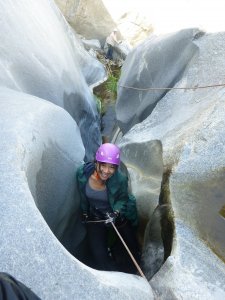
The approach hike involves rough rock scrambling through the hot desert, where at noon in April/May it may get to 110F. So Starting to hike at dawn and traveling light is a good idea. Carry enough water for the approach and plan to filter the rest. In Spring you can count on finding flowing water in the canyon, but in Fall it may dry up and have stagnant pools or not even that. Wetsuits are usually NOT required even in Spring. Waterproof jacket/pants + some undergarment should be enough for most people. Notice the “should”… most of the rappels will just splash you but some, especially the last set, may completely soak you. Pools change with sand deposits, they may get deeper or get blocked and become full swimmers. Be prepared for anything!
The descent is well documented by Chris Brennen, just skip the first section of narrows (3 rappels) and everything is more or less still valid. However, Chris team exited the canyon after 10h at evelation 2360ft, that is right before the set of narrows above the Psycodelic Eye. Those narrows are exceptionally beautiful and present 4 more raps that are a bit technical, but have good anchors from tree and pitons. The final rappel drops you in a pool at the edge of the Psycodelic Eye (famous ’70 rock art) which marks the end of the technical canyon at elevation 2020ft. The Eye is hidden behind a big boulder on canyon right, you won’t see it until you are right in front of it.
Most of the anchors are natural, usually webbing around a tree, bush or rock. Some are hard to spot, some may be missing and some may be too old. So bring webbing and rings and be ready to build anchors. You may need to use retrievable anchors if you run out of webbing (http://www.canyoneeringusa.com/techtips/tworingretrievableanchor/). Please try to NOT just sling rope around a tree and pull down from there. I know it’s easy and cheap, but if many people did that the tree would die.
The Exit
From the Psychodelic Eye one can find a faint trail on canyon left that takes you down to the valley and to the car.
Red Tape
The road to access the canyon from the bottom is closed from June to October for Big Horn breeding. You don’t want to be in the desert that time of year anyway.