The Hype
The Hog Springs Complex is a canyoneering playground with 4 separate technical slots, each with unique characteristics and difficulties.
Hog 1 draws it’s nickname from “Boss” Hogg, the wealthy and nefarious commissioner of Hazzard County in the famous television series “Dukes of Hazzard.” Some might say it’s also called “Boss Hogg” because it was the first of the Hog Springs Complex to be explored.
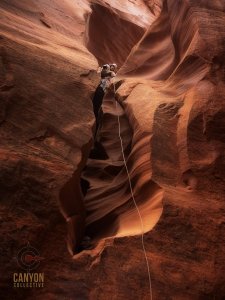
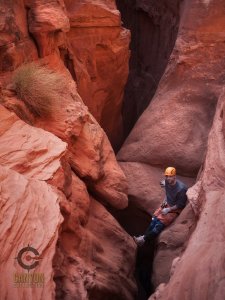
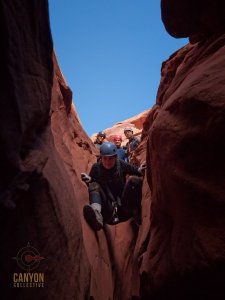
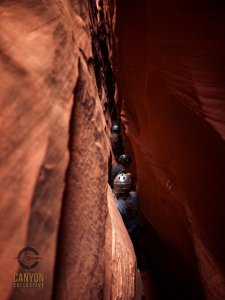
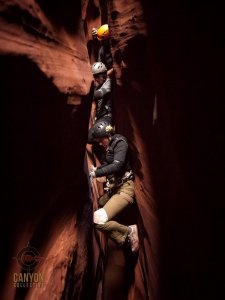
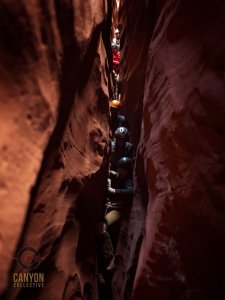
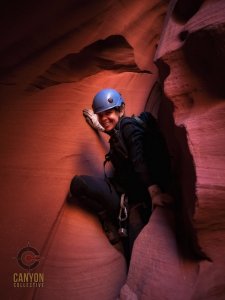
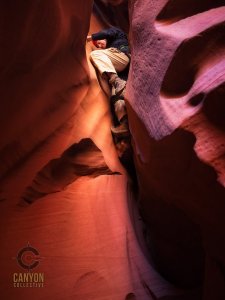
Boss has all the makings of a true villain, but ultimately all of it’s evil tricks are fairly easily to negotiate. While it only has a couple of rappels, the longest being 50 feet, this canyon is not beginner friendly. The obstacles are a step up in both difficulty and exposure from nearby North Wash fare. There are a handful of challenging downclimbs, as well as a significant stretch of sustained stemming.
Getting There
Access Road: Hog-Trachyte road is at mile marker 3.6 on state road 276. This road varies wildly in condition, and is subject to frequent washouts. Generally, high clearance and 4WD are required to reach the trailhead. Hog Springs TH is 2.1 miles from SR276, and is at the crest of a small hill.
This road is also the preferred access to all of the Hog Springs complex, and continues on to access Trachyotomy, Tik-Tok Bridge, and the “Land of Oz.”
From the Trailhead: Hike northeast across open and sandy terrain for about 10 minutes, until you catch a glimpse of the Hog Springs Complex. 4 technical slots are all approached from here. Continue following along the rim of the complex to the northeast for roughly 30 minutes, passing the first small tributary (Hog 4) and continuing on to the next obvious drainage. A few hundred yards before the head of the canyon, find a small break and scramble down into the navajo sandstone bowl, and make your way to the head of the technical narrows.
Optional Approach: It is common to descend one or more Hogs in a single day. The easiest way to climb back to the head of another slot is to climb the nose between the mouths of Hog 1 and Hog 2. The slab is about 30 feet, goes at around 5.6, and is all friction. At least one member of your party should be skilled enough to make this climb if you intend to double up on the Hogs.
The Canyon
3AIII R
Skills Required: Natural Anchors, Stemming, Downclimbing
Rappels: 50′
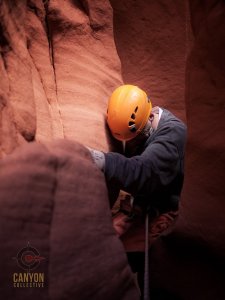
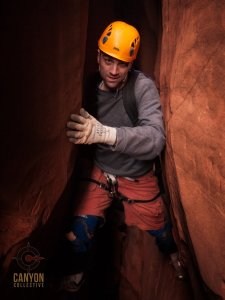
Hog 1 is filled with variety; interesting rappels, challenging downclimbs, and a clothes-shredding section of sustained off-the-deck stemming. Long pants, sleeves, and pads are highly recommended.
The longest rappel in canyon is 50 feet, but the actual distance on rappel is closer to 15 feet as the anchor is a ways back from the drop.
Exposure Risk: R
The canyon gets an R rating for a couple of sections of high stemming. Generally speaking, the stemming is straight forward, but if you are inexperienced or risk averse, consider descending other North Wash canyons first, and get a taste for the effort and exposure involved. This canyon is not recommended for beginners.
Natural Anchors:
North Wash is considered a “natural anchor” area. There are currently no bolts in North Wash. Please be competent with natural anchor evaluation and building skills, and plan accordingly.
Gear Recommendations:
Technical Canyoneering Kit – including helmet, harness, rappel device, ascending gear
Pads – Knee, elbow
Bunny strap
Flash Flood Danger: Low
The Exit
There are multiple options for getting back to your car after descending a hog. If you don’t have a car shuttle, use either the buttress climb, or the exit gully to get back up top. Hike down the main drainage to Hog Springs Rest Area if you spotted a car.
Exit Gully: The exit gully is a rough 3rd class scramble up a steep drainage with stretches of rotten rock. It’s not a beautiful exit, but it goes and gets you back to your car quickly. It is the first drainage that enters from canyon right, and is easily approached from between the mouths of hog 2 and 3. It trends northwest back to the rim.
Buttress Climb: If you are doing two hogs in one day, you’ll need to get familiar with the buttress climb. Between the mouth of Hog 1 and Hog 2 there is a low angle slab that requires about 15 feet of 5.4 climbing. It requires a careful sequence of moves, but is generally not that difficult. Once on the flat area of slickrock, you can simply follow the ridge back to the top, and either head back to your car or drop another slot.
Out the Bottom: If your car is at the Hog Springs rest area, begin heading downstream. Beware of poison ivy, and keep an eye out for a bench on river left that makes travel easier. Eventually, make your way back into the streambed, and back to your car.
Red Tape
BLM Land: Boss Hogg is located on BLM land, and currently there are no regulations or access issues.
Most slot canyons are found on public lands managed by the US Government, although a few can be found on private lands. The US Forest Service, the Bureau of Land Management, and the National Park Service manage these lands. Each area tends to have unique management issues. As a result, there is not a uniform set of rules governing our use of these lands. For current issues related to canyoneering access, please visit www.americancanyoneers.org.