This is a silly sport.
The whole thing. Sliding down ropes in remote places, risking death and destruction on a regular basis, for what?
Philosophical ponderings aside, the way to make it MORE preposterous is to do this stuff in winter, when there are additional hazards and the chance that even a minor injury could mean death. It is critical to do canyons you know well, bring extra gear and extra ropes, plan on a slower-than-normal pace, etc… and have no weak links on your team.
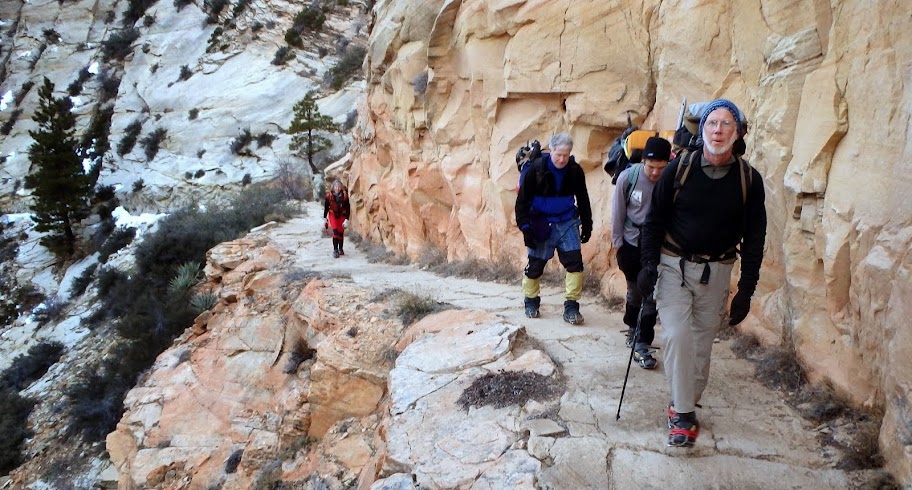
We do this each year in preparation for Freeze Fest. Ram came down to Zion for a quick run through Mystery, a fine moderate canyon that starts with a north-facing approach known as the Death Gully. We assembled a crack team – Jenny West, Ramoo, Tim Hoover, Mike Schasch and myself – and hiked up from Weeping Rock starting in the first light of dawn at 7am. As Ram says, it is better to have extra hours of light at the end of the day than at the beginning.
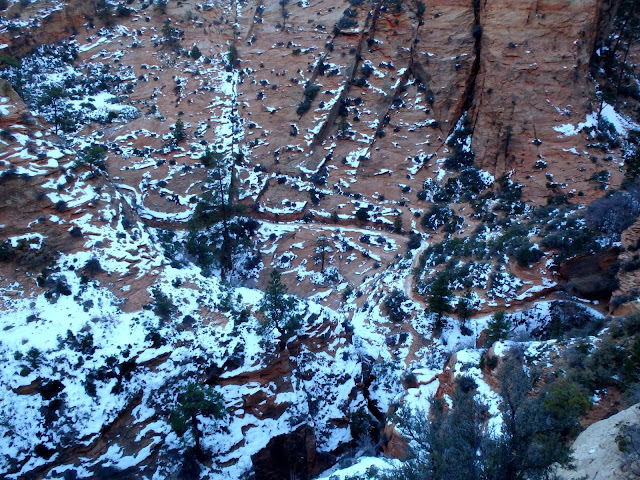
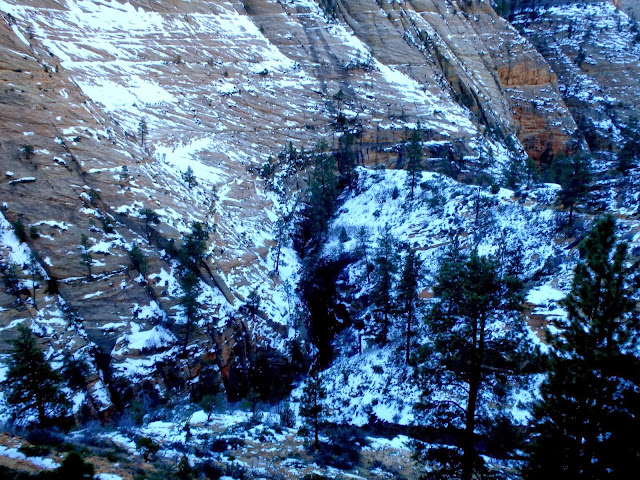
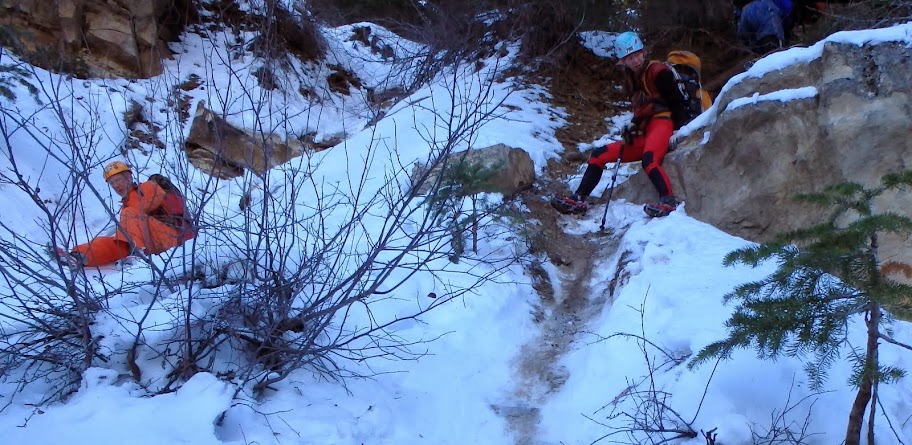
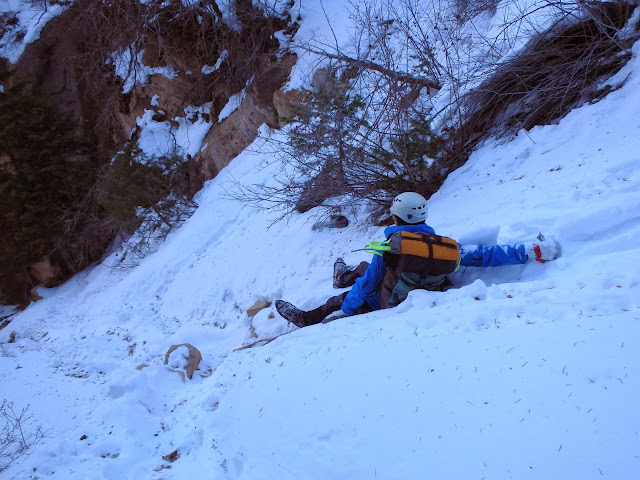
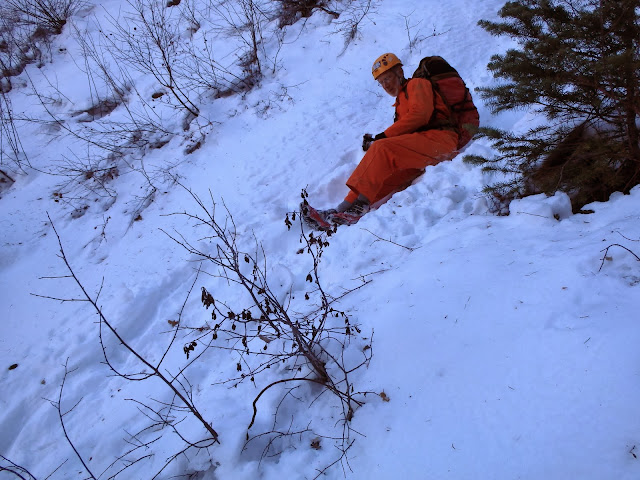
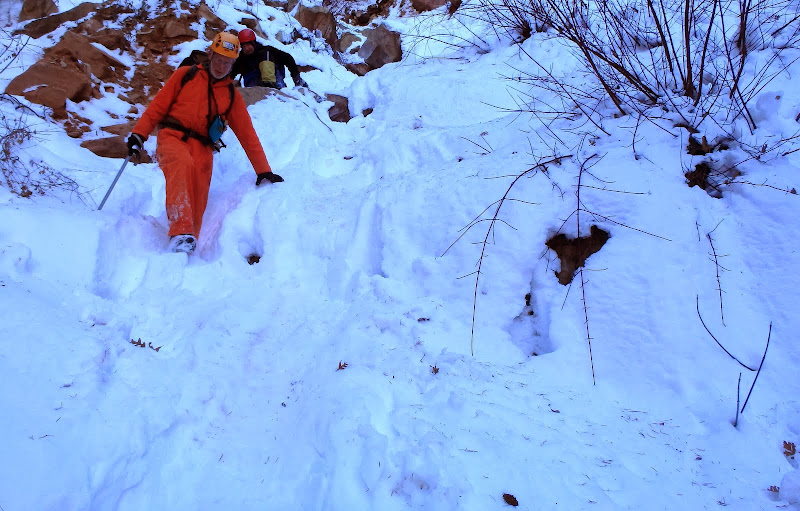
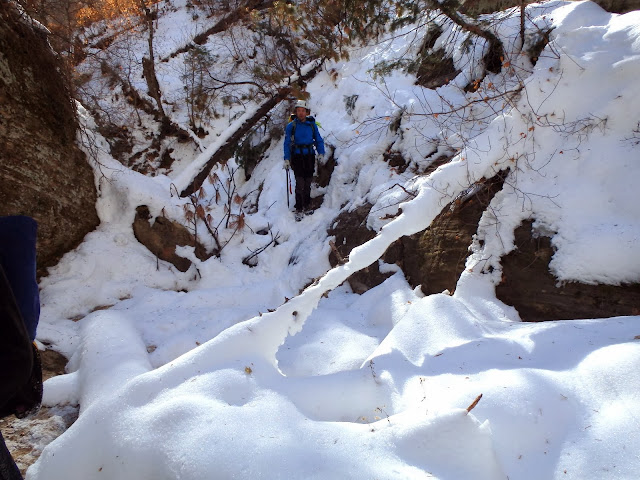
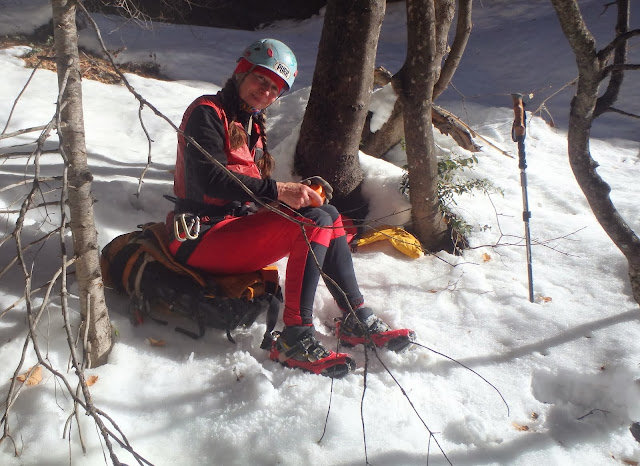
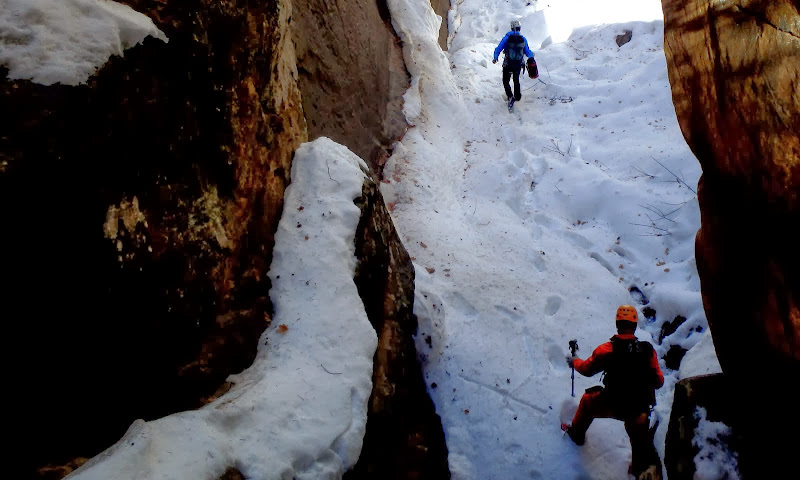
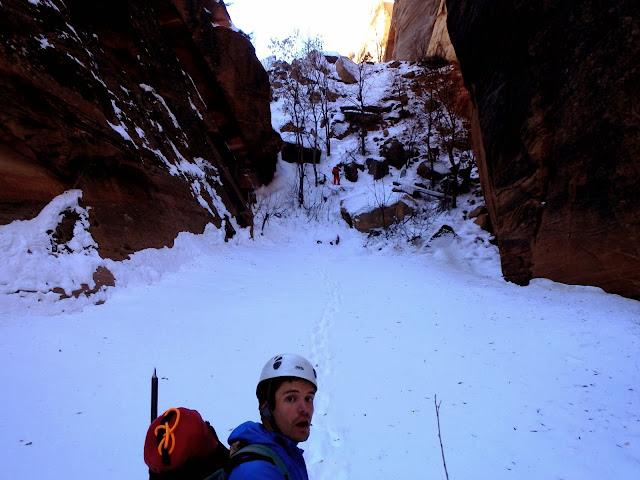
Creepers allowed reasonable hiking up the hill to the Obs Point Turn. Conditions were somewhat drier/less snowy than expected. The Gully of Death was snowy and slippery as anticipated, with snow conditions perhaps worse than expected. Tracks from a previous party actually made it harder, as they created a breakable crust over the 4″ of depth hoar. Traction was hard to get. Ice Axes, creepers, ski poles and buttocks were all used in abundance. It was tedious, but we all made it down safe and into the flat part of the canyon. A little light filtered in and, as the sun came around, a little direct light lit up the snow crystals and red walls. Truly delightful.
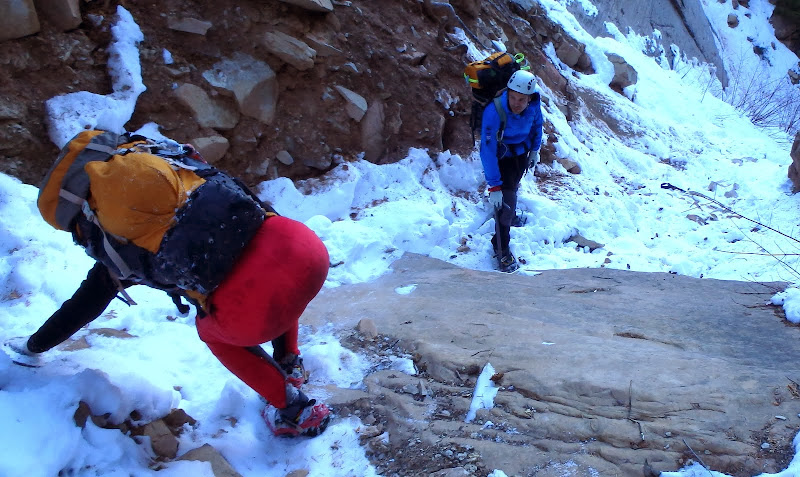
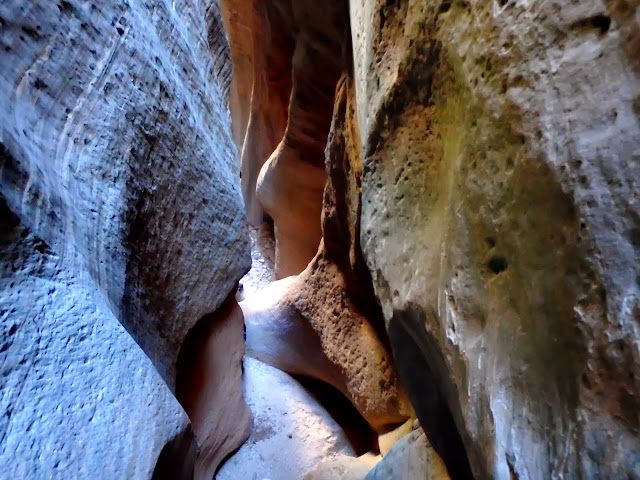
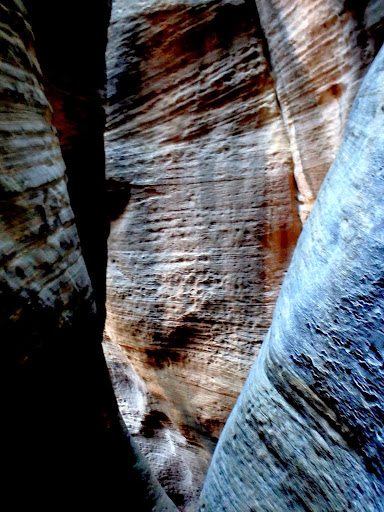
The rock narrows were mostly clear of snow, and our crack team made quick time through the technical part. Out into the East/West running flat part of Mystery was again snowy and cold. We discussed the possibility of the lake being present and difficult – but it was a flat with snow on it, and we were soon up the sandpile, booting down the steep west face of the pile. A few more obstacles and we were at the gear-up spot for the final bit. Suits were donned, dry or wet. Harnesses back on over massive amounts of clothes.
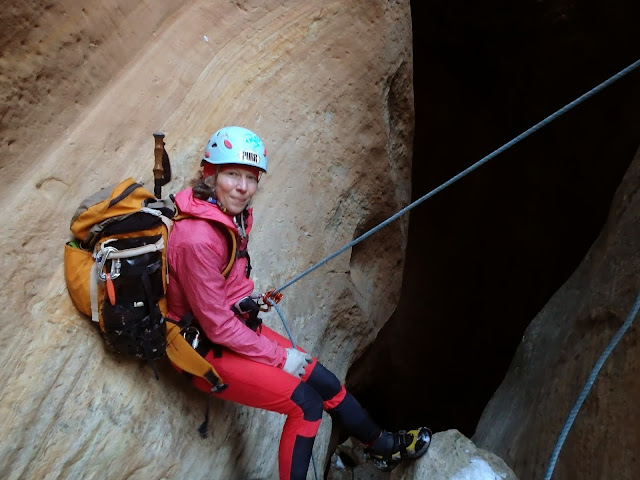
Mike traversed out and set the rope, and rapped down as the rest of us dilly-dallied with dressing. Jenny and I traversed over to the anchor, and Jenny set up on rappel. She dilly-dallied again, then leaned back to start her rappel. A funny sound was heard from her harness – she pulled back up – YIKES!!! Her harness was not fastened. We quickly temporized safety, and she traversed back to the prep area to shake out and get herself sorted out. Whew – disaster avoided.
Harness Interruptus – starting to put on a harness, then stopping to do something else, and not getting back to it. Don’t do this!
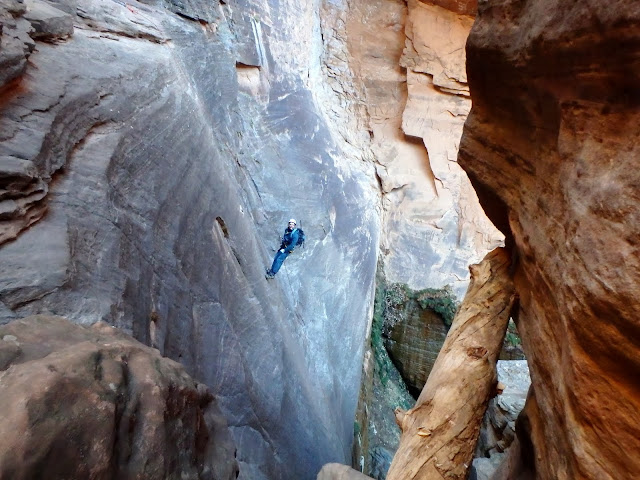
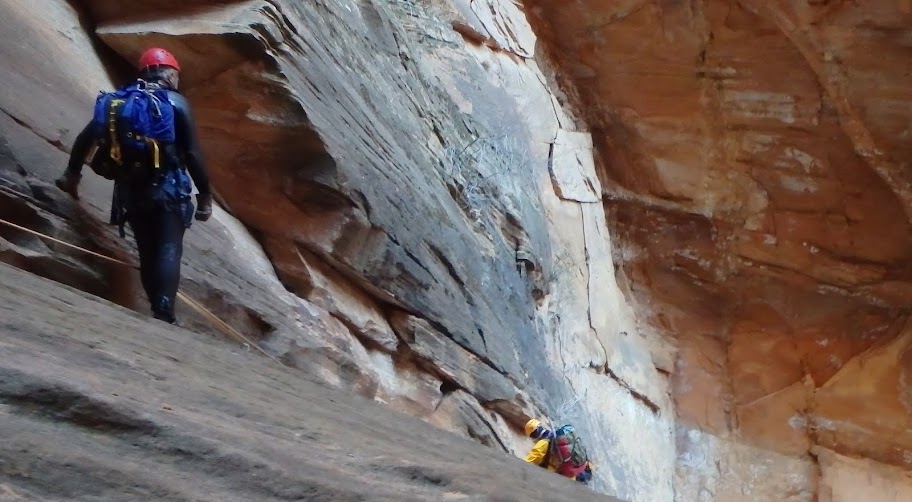
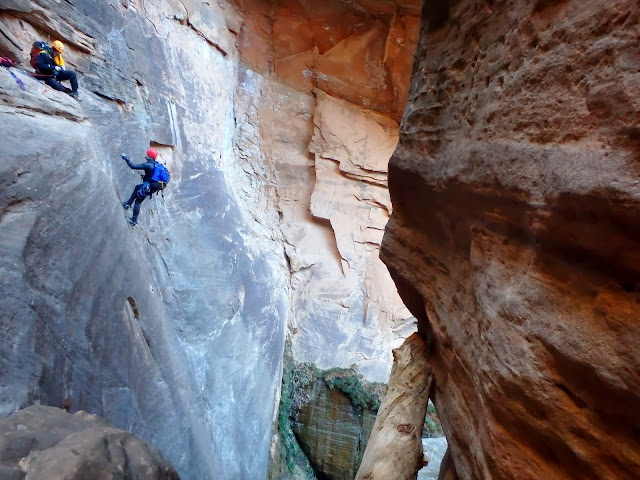
Back to the rappel. Tim went down after a careful check. Jenny came back and went down. Ram went down. I rigged the rap for retrieval and glided down the rope.
Through the jungle section, to the final rap, down the super-slippery wall, then a brief walk out to the veranda, and back to the car at the Temple of Sinawava about 5 pm. We were amazed at the number of people on the Gateway to the Narrows Trail, and in the Park in general. Love that the Park is enjoyed by many even in tough conditions.
thanks to Mike for letting me use his pics, since neither of us took all that many…
Mountaineer
I’m looking through the pictures, and tried counting how many clothing options you all had. All pictures from the same day, right?
Did you sequence from trek/hiking clothes, to (jump) snow suits then to drysuits/wetsuits?
Overalls “over” the wetsuit? Interesting, may protect the wetsuit from getting ripped up more.
Ram
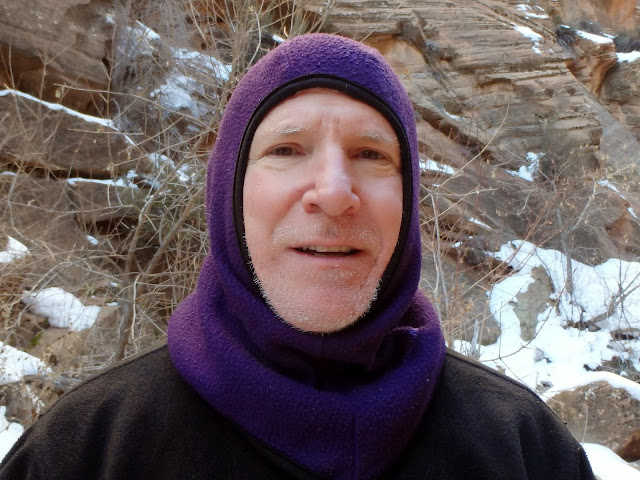
I hiked up in long johns, shorts and synthetic top, with a splash jacket over the top. For the snow slide down the gully, I added a ripped up puffball between the top layers and added neo shorts below. I was in synthetic and wool sock combo. I think Jenny and/or Tim had gaiters, which I left in the car. For the final wet sequences, I used a 3/2mm wetsuit, neo shorts and socks along with splash jacket. The neo hat came on and off, under the helmet, all day long depending on exertion levels.
ratagonia
I brought a drysuit and wore it at the end, but used the overalls after the hike up, to protect from the snowy descent. Worked like a charm. Once at the final rap sequence, I put on the drysuit, but NOT the overalls, since the body contact with rock after that point was minimal. Other people made other choices.
Tom
cirrus2000
Wow, Jenny – that’s a scary story, right there. Glad you made that double check! I always make a point to check one last time just before I weight a rappel, and have spotted once or twice that I haven’t locked my rap biner, but haven’t had an incompletely buckled harness… yet!
All in all, looks like an amazing trip, with a great crew. One of these days, I’ll have to extend my FF time and do some Zion stuff – I’m always fascinated seeing the winter photos of that place, which means so much to me!
Ram
My take on the Mystery day plus pictures…
The initial trail up to Observation point was icy. Micro spikes were a tremendous help. As we got to higher altitudes, the ice became spotty, as more sun reached the trail and a bit of south exposure mixed in with the prevailing western exposure. The ice is created by hikers on the snowy trail. Once on the top, we encountered patchy Styrofoam like snow and frozen soil in about equal proportions. That snow appeared to be melting during the day and the frozen ground showed evidence of becoming muddy during the middle of the day too and then freezing again overnight. The Death Gully, with its north exposure was snow covered, often a foot or more deep. Not as much snow as anticipated. Another group (of 3?) had been down days before us and their tracks helped in places and hurt in others. On the steeper ground, many of us just dropped to our butts, used poles, axes and arms as rudders and brakes, and slid down the hill. It is hard to fall when you are already on the ground. One needed to watch for those sharp covered rocks though.
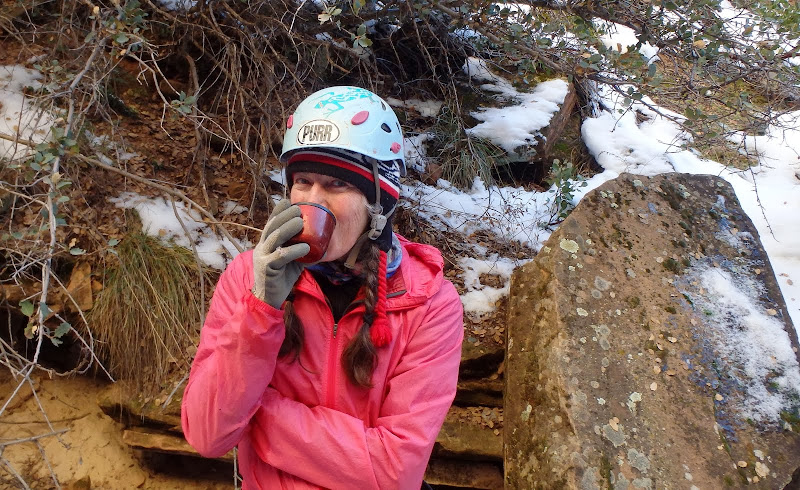
I found it more dangerous when the angle eased, as we were forced to our feet and many holes in the unconsolidated sugary snow, made the twisting of and ankle or knee a real possibility. All the way to the raps, the descent took unceasing concentration. We took a lovely break in the snow for hot tea and soups, along with food. It was quite beautiful, the world coated in snow.
Once at the rap stations, we broke into our roles and moved through the drops with great speed. It actually was the most mentally restful part of the day, as their was little snow to hurt one’s self on. below the raps, I was surprised to see the mid canyon section with as much snow as the death gully. I know it is east-west trending and the walls are high, but I thought it would be open enough and lower altitude, that it would be drier. Instead, it required the same vigilance and care as the upper canyon.
The lower canyon, between the 2 raps had evidence of that much ice had fallen recently. The upper walls were pretty clear for us, but it was obvious that this area was a shooting gallery of ice, fairly recently. Out the bottom and over to Tim and Sue’s for lasagna, fresh bread and other delicacies. A lovely day that was quite mentally challenging, as almost every step required care. Very worth it to see this spot on the planet many of us know so well, draped in a blanket of snow.
Pictures?
Jenny
I wish to add emphasis to this from my personal experience. I get out in the canyons a lot! The odds of an occasional screw-up are in my favor therefore. At this particular rappel, on that particular day, this “screw-up” could have cost me my life. Certainly it likely would have resulted in a serious injury. I usually use a BD Alpine Bod harness (it is light, fairly inexpensive and I go through several in a year). I hacksaw off the secondary back-up buckle to facilitate my arthritic hands in the fastening of the waist strap. Those of you who don’t know this harness; the rappel biner attaches over the main strap near the waist buckle and links to the crotch loop and takes the entire load (with minor assist from the leg loops, of course). In other words, I attached my rappel device, via the carabiner to the waist strap but failed to complete the buckling procedure.
YIKES! Seriously! Something was askew, I noted that. It was hard to see over the zipper of my drysuit and I struggled with gloves, multiple layers, the exposed journey to the anchor, etc. Finally, I felt with my hands that I was clipped in correctly, locked the biner and unclipped from the anchor strap to begin the rappel. Sensing that something was still not “right” I unweighted the rope and gave myself a good visual inspection and asked Tom to do the same. The problem was clear. Tom grabbed the end of my waist strap, hanging limply through half of the buckle and tied a knot. Thanks, Tom!. I retreated to begin again and regain my composure. Whew! REALLY!
Here’s my point, folks. I ALWAYS DOUBLE CHECK MYSELF AT THE RAPPEL! ALWAYS! I make it a habit. It has saved my butt several times. Three other times, I was set to rappel off the biner blocked side of the rope and caught my mistake on the second check. Often, my partners hear me request that we double check each other at each rappel. If you’re the last person, you better make it a habit of checking yourself; ALWAYS.
Tom is kind to not exaggerate the impact of this particular mistake on my part. It scared me very much. I hate to be scared. I don’t process the adrenaline well anymore. I avoid fear. This filled me with fear and I hope that I can inspire you all to ALWAYS double-check yourself and your partners at EVERY rappel.
Kuenn
Jenny,
This is an invaluable reminder and lesson to us all, regardless of experience level or years on-the-job. Double check and calls for safety check are not signs of a neophyte or incompetence, nor should it ever be viewed as such. It is, rather, a characteristic of astuteness. Fatigue, frustration with gear, awkward starts, untimely questions, weather, psych outs…the list is endless that contribute to a momentary loss of focus. These checks have saved my keister and many others that I’ve witnessed more than once.
Thank you for elaborating on and sharing this. It means even more to me considering your level of expertise.
townsend
Can’t be stressed enough, and well stated. In canyoneering, we learn the principle of redundancy in anchor systems to mitigate risk. Double checking the entire set up is simply applying redundancy everywhere, from Anchor (all aspects) > Buckles (= harness) > Carabiner > Descender (= ABCD), and double checking other aspects of set up (direction of pull, rope for damage, length of rope, etc.) as well. Redundancy is providing a fireman’s belay–a second brake hand, should the first fail. Double check yourself, and also have a partner check your set up. If that ends up being a “triple check,” more power to it.
TJ Cottam
Looks like a great trip. Glad to see you didn’t run into what we deemed the ice cave of death on a winter descent in 2011. The canyon was completely blocked by an ice fall coming off the rim.
ratagonia
Whoa – scary – what did you do???
Tom
TJ Cottam
We hurled a large rock at it that punched a hole through the ice that was just large enough to crawl through without your pack on. From there we gently anchored off a horn of ice that had formed on the floor and downclimbed with the rope as a backup.
Ram
Where exactly in the canyon did you encounter this? Crazy, TJ! Lucky the ice was thin/brittle enough that a sandstone projectile could impact the ice. Visions of trying to chop thru ice with a pocket knife of the side of a helmet edge
dweaver2130
The wife and I had speculated what it would look like in winter when we were there early in the fall. Seemed protected from getting snowed on, but figured it would be an icy spot.
Ram
It was more slippery getting TO the ledge both from up canyon and below, than on the ledge proper. In this case, that was due to sand.
In winter, the lack of sun seems to often make sandstone slightly damp. Mix in thin or thick lichen, which become treacherous in these damp conditions and it can become deceptively slippery. Interestingly, soaking wet/drenched can actually be much more grippy. Wingate Sandstone in the winter MUST be particularly respected even at the lowest angles and no exposure. You can come down HARD on your hip or knee, in an instant. We are often forced to rope out pitches to get up and rap down 3rd and 4th class terrain, on that rock, in the winter.
On this day, we had considered the possibility that rapping the watercourse versus the ledge would be appropriate. It was not necessary. I remember when the bolts and fixed lines appeared on the ledge approach. I was surprised that they became accepted. I can think of no other class 1-2 spot anywhere that has fixed support like that
A lovely day where the rappels may have been some of the safest places in the canyon. That snow was old and changed to the consistency of sugar in many places, the result of a largish storm followed by sustained cold. The snow was about as dry as snow gets. Very little consolidating when boots weighted down on it. Enough snow to cover holes, dry enough snow to make falling into to them quite easy. I thought the steeper slopes safer. You could sit and lay down and slide them. On flatter ground, it is more difficult not to fully weight with each step.
dweaver2130
Wow, very beautiful under snow!
How was the ledge at the springs rappel?
ratagonia
It was dry. Two safety lines were in place, which we left.
Tom
gloo
Hey Tom, do you think a 7mil wetsuit is sufficient for mystery and other such canyons in the dead of winter?
ratagonia
It depends. I don’t know how your body responds to cold.
Each canyon is different. Mystery has water only at the end, and perhaps at the Lake. So the exposure to water is short. For that, a 4/3mm is probably sufficient, assuming well-fed and good air temps like we had. Other canyons – more likely 7mm would be required for longer exposure to cold water. This is really where dry suits come into their own.
Tom
Mountaineer
Nice job team! Huge accomplishment. Ice axes? Great idea for the gully.
Agree this activity has its risks, but combining that with snow and ice requires a lot more of everything.
Loved the report.